
September 15, 2026
11:00 AM · central Mexico
GENGHIS KHAN: THE BUTCHER WHO BUILT THE FIRST GLOBALIZATION
The thesis: the man responsible for the greatest proportional massacre of a population in human history is also the unwitting architect of the first network of trade, religious tolerance and secure mail on a continental scale the world had ever known.
Original soundtrack · GENGHIS KHAN
0:00 / 29:35I · The story
Chapter 1 of 6The Orphan of the Onon
To understand how one and the same man could be the architect of a safe road and the author of a massacre, we must go back sixty years, to a boy with no clan, no father, no name that anyone yet feared.
Around eleven sixty-two, near the Onon River, in the hills of Khentii, Temüjin was born. The sources cannot even agree on the year: some place it seven years earlier, others five years later. What almost all of them do repeat is the legend that surrounded his arrival into the world: they say he was born with a clot of blood clenched in his fist, as though he had already come gripping something he had no intention of letting go.
His father, Yesügei, was a minor chieftain of a clan with no real weight on the steppe. He died poisoned by rival Tatars around eleven seventy-one, when Temüjin was barely nine years old. What followed was not a period of mourning. It was a calculated abandonment. The Tayichiud clan, whose duty was to protect the widow Hö'elün and her children, turned their backs on them and took the herds. On the Mongolian steppe, to be left without livestock is to be left without life. The family survived on wild roots, river fish and marmots that Temüjin himself learned to hunt before he turned ten.
That early hunger taught him something no court adviser could ever have taught him afterward: that the loyalty of blood, the loyalty that was supposed to be sacred, snapped as easily as a strip of cured leather in the depths of winter. He would spend the rest of his life building a system that did not rest on lineage, but on oath. Yet before he could build anything, he had to survive his own allies.
Around eleven seventy-eight he married Börte, of the Onggirat clan. Two years later, Merkit warriors raided the camp and carried her off. Temüjin, still without an army of his own, turned to two men: Jamukha, his sworn brother since childhood, with whom he had exchanged the anda oath over a goat's anklebone, and Toghrul, khan of the Kereit, an old ally of his father. Together they recovered Börte. It was the first alliance that held Temüjin up. It would also be the first that, years later, he would have to break with his own hands.
For two decades he accumulated warriors, defeats and lessons. He fell before Jamukha himself in an early battle. He rose again. He absorbed entire clans by offering something the steppe had never known: advancement by proven merit, not by inherited blood. A shepherd with no name could come to command a thousand men if Temüjin trusted him. That promise, more than any composite bow, was his most effective weapon.
The alliances that had once saved him became, one by one, threats. In twelve oh three he defeated Toghrul, the very khan who had helped him rescue his wife. The following year fell the Naiman of Tayang Khan, the last great rival power of the western steppe. Only one name remained. The oldest. The most painful to speak.
Jamukha had become the voice of all those who resisted Temüjin's authority. The loyalty that had saved him as a boy was precisely what he had to destroy in order to become khan. The Secret History of the Mongols tells that, around twelve oh five or twelve oh six, Jamukha's own followers handed him over as a captive. How he died, and what he asked for before dying, is a story that belongs to a later chapter. Here it is enough to know that he died, and that with him died the last alliance of Temüjin's childhood.
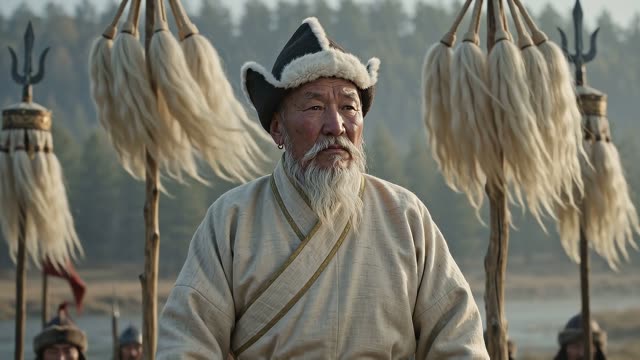
In twelve oh six, beside the Onon River where he had been born with no name that anyone feared, the chiefs of all the Mongol peoples gathered in a kurultai and proclaimed Temüjin as Genghis Khan, lord of all who live beneath felt. He organized the army into decimal units — arban, zuun, mingghan, tumen — where command was not inherited but earned. He issued a written code of laws, the Yassa, something the steppe had never known. The orphan who had survived on roots beside the Onon was, in his mid-forties, the most powerful man ever seen in that land.
That code would be born, in part, of a betrayal: that of a man who had once been closer to Temüjin than a brother of blood, and of the precise manner in which Genghis Khan decided that man should die. That will be told later. What was etched beside the Onon River that year was not merely a title. It was a silent warning to anyone who still believed that blood weighed more than oath.