

Coming soon on YouTube
JEWS IN MEXICO, JEWS IN POLANCO
The thesis: what today looks like a settled, visible community in Polanco is the most recent layer of an architecture built by hand, door by door, generation after generation, by people who arrived without a trade, without the language and without any guarantee of staying. A hundred years of a journey that began selling on instalments, house by house. The myth this film takes apart is «what is prosperous was born prosperous».
Original soundtrack · JEWS IN MEXICO, JEWS IN POLANCO
0:00 / 36:18I · The story
Chapter 1 of 9The one who didn't have the language
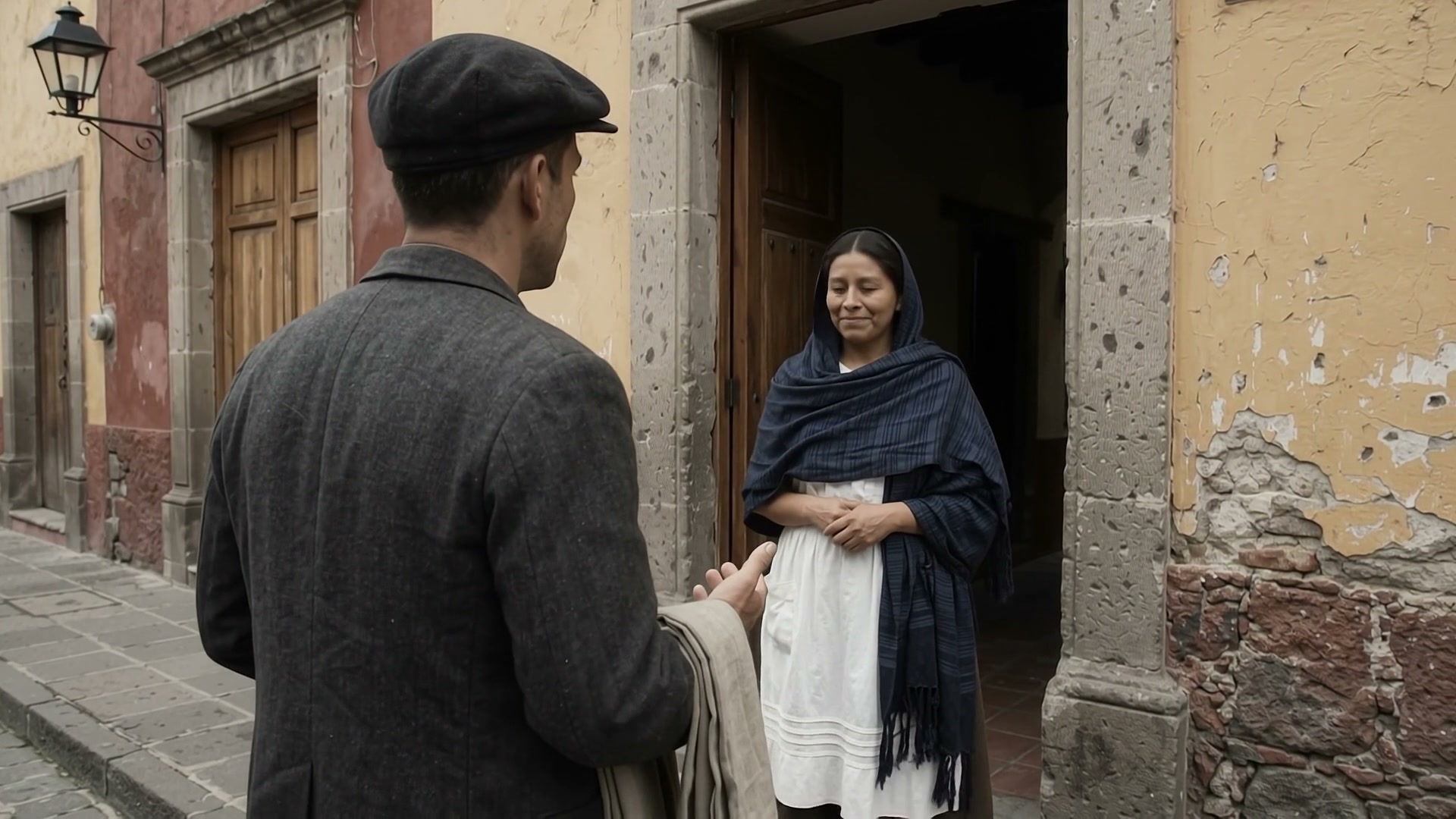
A man walks by night down a street in the historic centre of Mexico City, around nineteen twenty. In his hands he carries a fistful of needles, pins and imported fabrics: merchandise to sell on installment, door to door. He speaks no Spanish. He knows no one in this city. He brings no trade. He brings not even the language. He brings what fits in his hands, and a hundred years ahead of him that he did not yet know he would build.
The street is almost dark, lined with colonial stone façades that can barely be told apart. No one else is walking at that hour. No one on those blocks knows his name. Nor does he yet know which of the streets of the centre will end up being his own, or whether he will stay long enough to find out.
The image shifts. Now it is dawn over Polanco, in the year two thousand twenty-seven, seen from the air: pale stone façades, synagogues, schoolyards filling with voices, the metal shutters of shops rising one by one along the same avenue.
This did not arrive with that man. It came later. Much later. And almost no one knows what it cost.
It is easy to look only at the crown of a hundred-year-old tree and assume it was born that way, leafy, with no visible root beneath the pavement. That is what we do with Polanco. What is perceived today as a settled community, prosperous from the start, is in truth the most recent layer of something built by hand, door by door, over a hundred years. Prospering was not the starting point of this story. It was the part that took the longest to arrive, and the only one that ended up in plain sight.
The National Institute of Statistics and Geography counted, in its census of the year two thousand twenty, fifty-eight thousand eight hundred seventy-six Jews in Mexico: barely a minute fraction of the country's population. And yet one need only cross Presidente Masaryk Avenue any morning to feel a presence that seems to have been there forever, as solid as the stone of its façades. If you walk through there, you see the crown of the tree. This investigation goes after the root.
Because the man on the nameless street and the avenue of polished façades are not the beginning and the end of a straight line. Between the one and the other lie a hundred years of decisions no one made out of comfort: forced moves, trades taken up for want of any other, and invisible walls between people who in theory shared the same faith but not the same language nor the same rite. We will travel that whole distance, without yet revealing how it was closed.
But before following him down those streets there is a simpler question, and it remains unanswered. Where exactly did this man come from? Of all the corners of the world where, in those years, a Jew could find himself forced to flee, why did he end up crossing precisely this street, in this city?